The plant comes from North America. The Royal Horticultural Society describes a popular explanation for its name: the English word “Jerusalem” may be a corruption of the Italian girasole, meaning sunflower. Missouri Botanical Garden records the use of the tubers by Indigenous peoples of the Americas before 1600 and their arrival in Europe in the early seventeenth century. This is a documented history of cultivation, rather than a date for the invention of the pickle.
Vegetables / Pickled in vinegar
Spiced Pickled Jerusalem Artichokes
Crunchy tubers with turmeric and a sweet, tangy spiced pickling liquid. This tested recipe uses vinegar and boiling-water canning, rather than fermentation.
Storage
Store correctly processed, sealed jars in a cool, dark, dry place, ideally at 10–21°C. Use within a year for best quality. Once opened, refrigerate at no more than 4°C and use clean utensils. The recipe source gives no separate storage period after opening. If you discover a failed seal within 24 hours of correctly processing the jars, refrigerate and use within a week. Never taste food from a jar with a lost seal, mould, leaks, a bulging lid or any other signs of spoilage.
Instructions
Download printable PDFRecipe card to download and print
0 / 8 steps completed
Prepare the water-bath canner
Heat the water in a covered canner fitted with a rack to about 60°C. Use Mason canning jars of the specified size with two-piece metal lids. Wash the jars and keep them hot. Prepare the lids according to the manufacturer’s directions. For a recipe that requires overnight soaking, prepare the canner and jars on the day you fill them.
Prepare the tubers
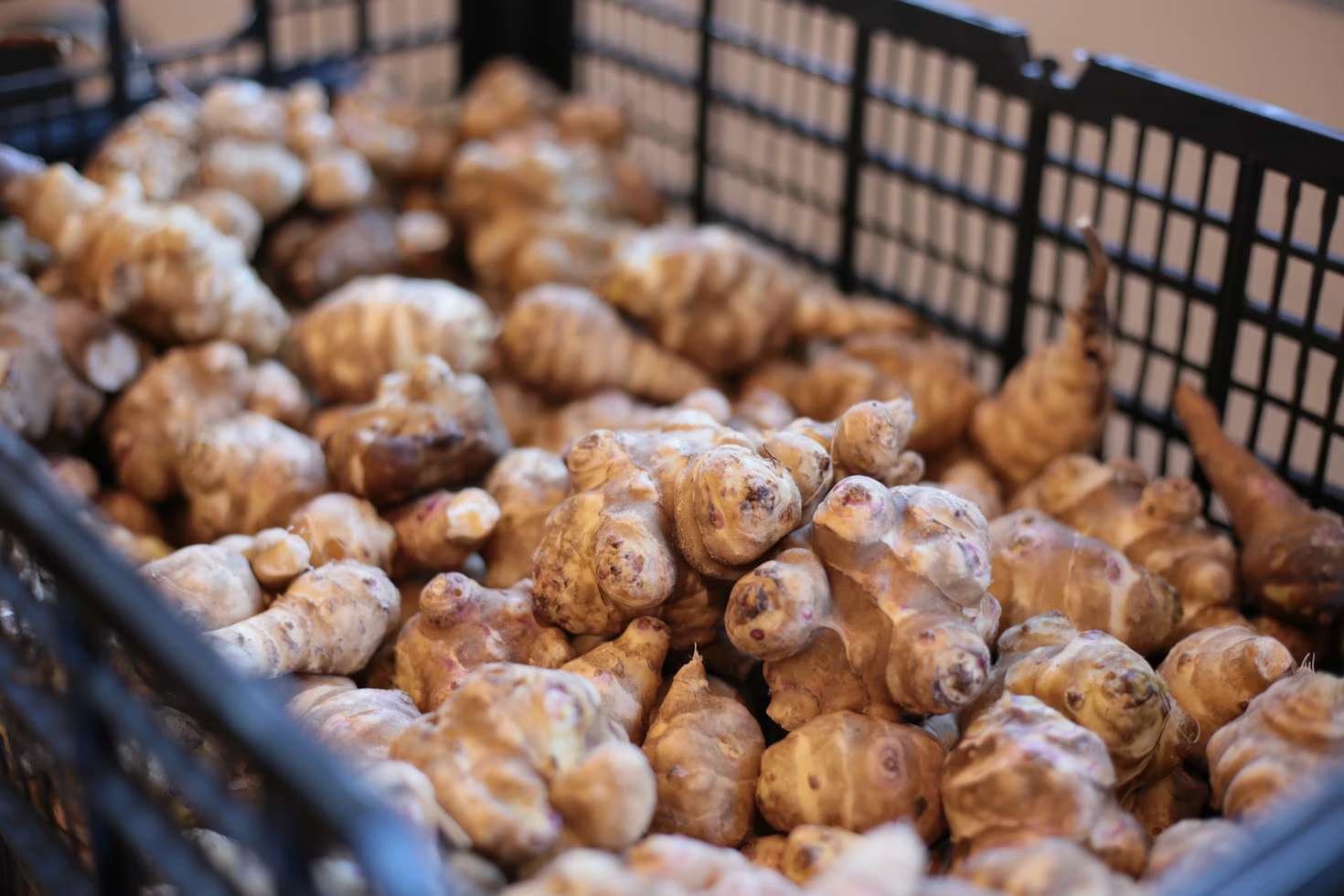
Scrub the Jerusalem artichokes thoroughly under running water and cut into chunks. Place in a food-safe container.
Soak for 24 hours
Cover the Jerusalem artichokes completely with 5% acidity vinegar. Add the salt and 4 tablespoons of turmeric, mix and leave for 24 hours. This is a vinegar soak, not fermentation.
Make the pickling liquid
About 30 minutes before the soaking time ends, combine the 1 US gallon (about 3.8 litres) of 5% acidity vinegar, sugar, spice bag and 2 tablespoons of turmeric. Simmer gently for 20–25 minutes, then remove the spice bag.
Pack the hot jars
Drain the Jerusalem artichokes and discard the soaking liquid. Pack the tubers into hot jars, adding one medium red pepper to each. Leave ½ inch (about 1.3 cm) headspace.
Add the hot pickling liquid
Pour in the hot pickling liquid, leaving ½ inch (about 1.3 cm) headspace. Remove air bubbles and recheck the headspace. Wipe the rims with a clean, damp paper towel and fit the two-piece lids according to the manufacturer’s directions.
Process in boiling water
Place the jars upright on the rack in the preheated canner. The water must cover the lids by at least 2.5 cm (1 inch), or at least 5 cm (2 inches) if processing takes more than 30 minutes. Cover and bring to a full rolling boil. Start timing only once the water is boiling: 10 minutes at elevations up to 304.8 m (1,000 ft); 15 minutes above 304.8 m and up to 1,828.8 m (6,000 ft); 20 minutes above 1,828.8 m. Keep the water boiling throughout. If boiling stops, bring the water back to a full boil and restart the entire processing time.
Cool and check the seals
Turn off the heat, remove the canner lid and wait 5 minutes. Lift the jars out upright. Leave them undisturbed for 12–24 hours. Do not press down on the lids or retighten the bands. Check the seals, remove the bands, then wash and dry the jars and label them with the date.
Tips
This is vinegar pickling, not fermentation. Do not replace the specified 5% acidity vinegar with homemade vinegar, kombucha or vinegar of unknown acidity. Keep the ingredient proportions, jar size, headspace and full processing time unchanged.
One US cup is 236.6 ml; one US pint is 473.2 ml; one US half-pint is 236.6 ml. Gram equivalents for ingredients measured by volume are approximate. Use the original volume measures when following this recipe. Do not apply these processing times to larger jars.
A home-canning processing time does not validate commercial production. Changes to batch size, packaging or ingredients require assessment of the process and shelf life of the specific product.
Allergens: pickling spice mixes may contain MUSTARD, CELERY or other allergens. Check the full ingredients list and the vinegar label. Under EU rules, sulphites must be declared above 10 mg/kg or 10 mg/l in the finished product; use the specifications of the ingredients you have chosen.
The source does not specify the variety or heat level of the red peppers. Do not increase the number of peppers or the volume of tubers.
How to serve
Serve as a tangy, spiced accompaniment to roast meat, pâté, cheese or cold cuts. Finely chopped pieces can also be added to potato salad when serving.
Recipe sources
- Kew Science · Plants of the World Online
- RHS · Jerusalem artichokes
- Missouri Botanical Garden · Plant Finder
- Clausen et al., 2012, Journal of Agricultural and Food Chemistry
- National Center for Home Food Preservation · Artichoke (Jerusalem) Pickles
- NCHFP · Using Boiling Water Canners
- Regulation (EU) No 1169/2011, Annex II
- NCHFP · Using Boiling Water Canners
- NCHFP · Storing Home Canned Foods
This recipe is based on the sources listed above.
What will you make next?
 01New / unusual
Vegetables · Pickled in vinegar
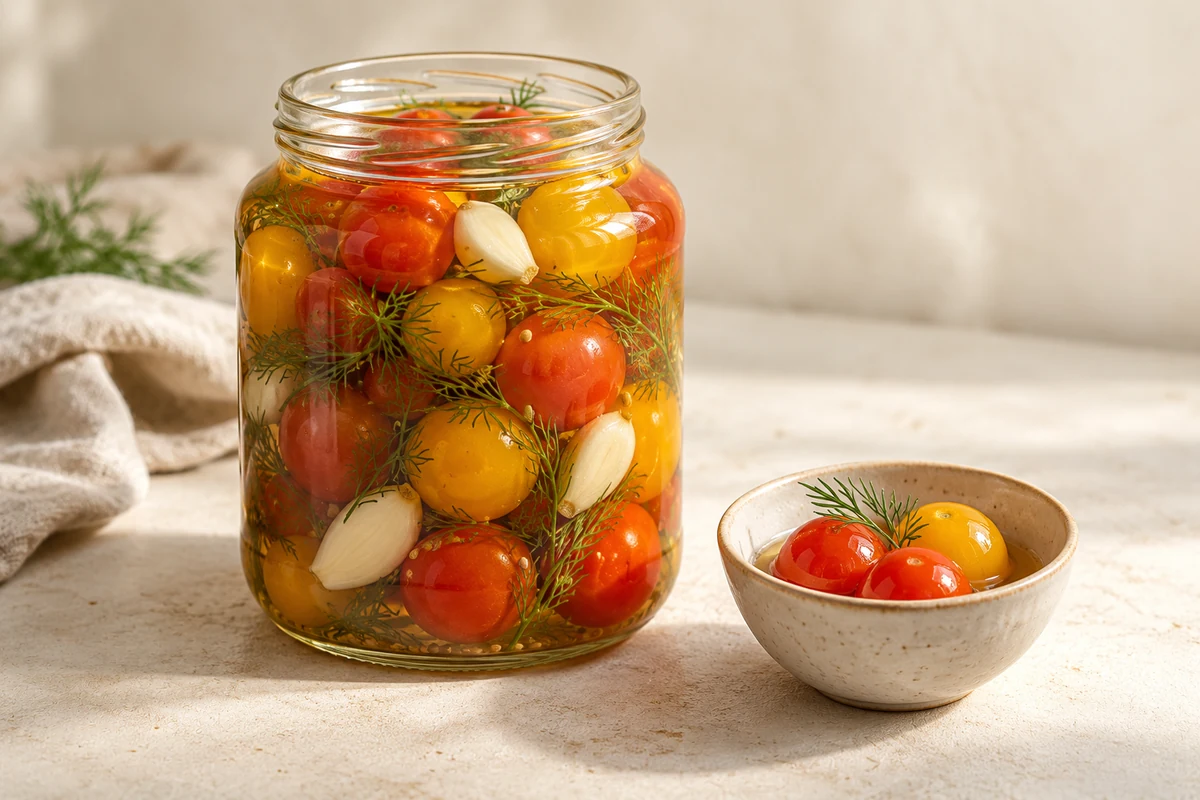
Pickled cherry tomatoes with honey and dill
Peeled cherry tomatoes in a sweet-and-sour pickling liquid with honey, garlic and dill. Adapted from Ann Low’s recipe, also published in Gourmet Living magazine.
50 minutes + 3 days in the fridge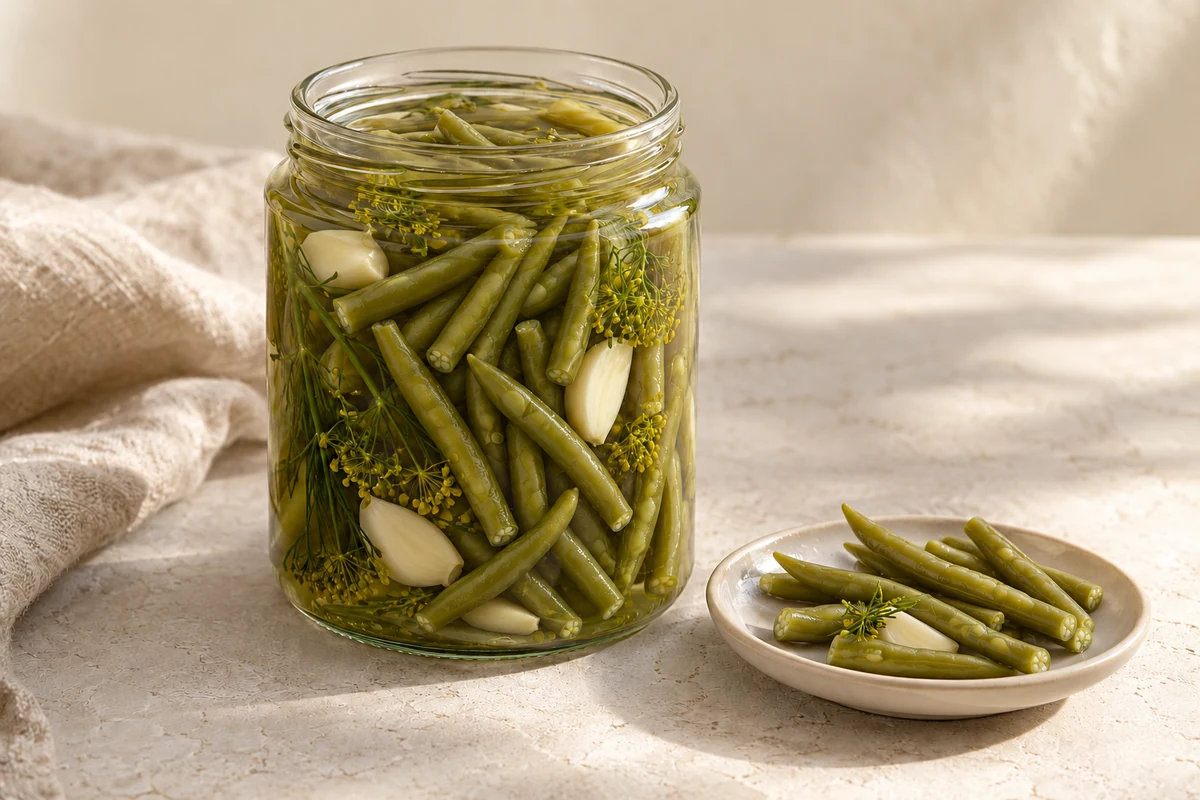 02New / unusual
Vegetables · Pickled in vinegar
Pickled green beans with horseradish and lemon
Green beans pickled with chilli, horseradish and lemon, from Hege Marie Köster’s recipe in essen & trinken magazine.
30 minutes prep + 90 minutes cooking + 2 weeks maturing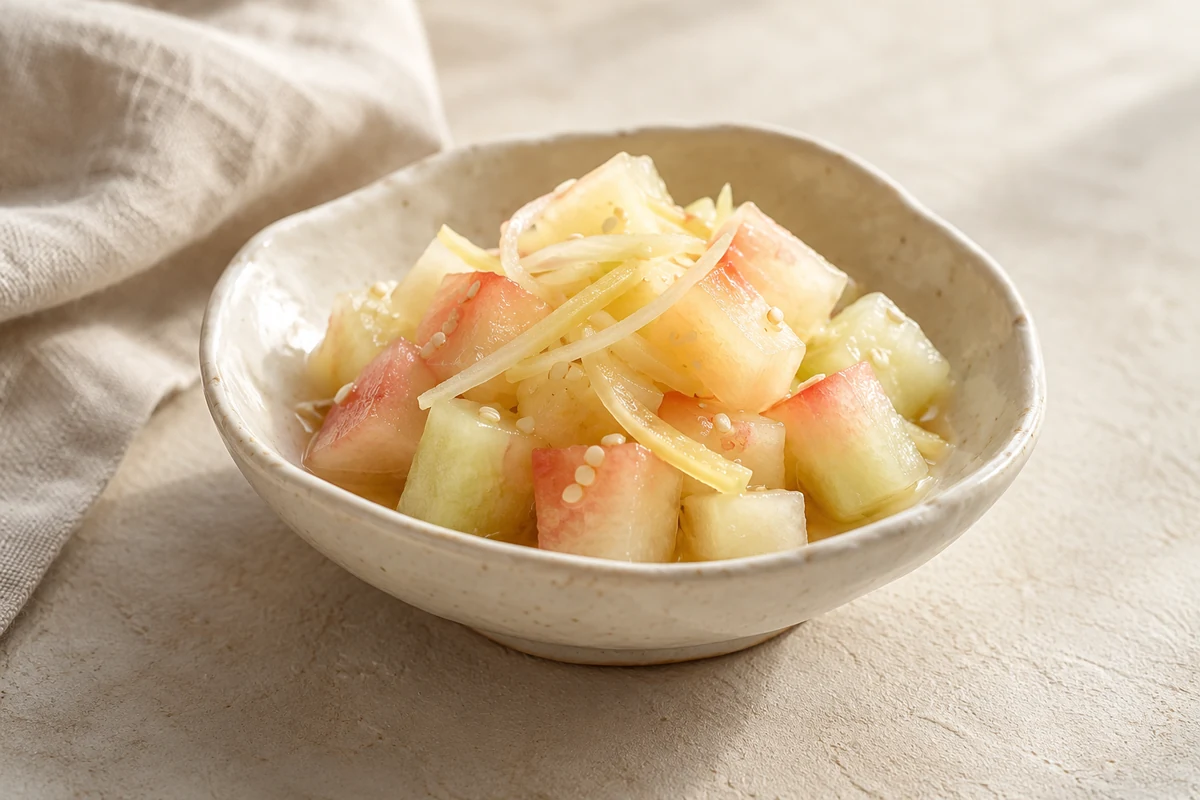 03New / unusual
Vegetables · Pickled in vinegar
Japanese pickled watermelon rind
Crisp white watermelon rind in a sweet-and-sour marinade with soy sauce and sesame oil. From Namiko Hirasawa Chen’s recipe at Just One Cookbook.
20 minutes prep + 2–3 hours chilling